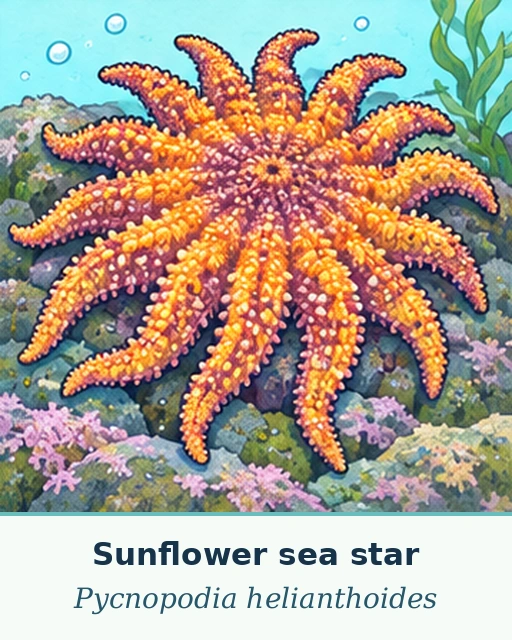
Scientific name: Pycnopodia helianthoides
About the animal
This large sea star is an active hunter. It eats sea urchins and other animals on the seafloor.
Where it lives
Its historical range stretches along the Pacific coast of North America from Alaska’s Aleutian Islands to Baja California, Mexico. It lives on reefs and in kelp forests and seagrass beds.
Global conservation status (IUCN)
Critically Endangered.
Estimated population
A reliable current total is unknown. Researchers estimate that a disease outbreak starting in 2013 killed about 5.75 billion sunflower sea stars, roughly 90% of the population at the time.
People and this animal
Scientists and aquariums are raising sunflower sea stars to help restore wild populations.
Fun fact
A large adult can have up to 24 arms and move on thousands of tiny tube feet.
Sources
https://doi.org/10.2305/IUCN.UK.2021-1.RLTS.T178290276A197818455.en
https://www.montereybayaquarium.org/animals-the-ocean/animals-a-to-z/sunflower-star
https://www.fisheries.noaa.gov/species/sunflower-sea-star/resources